How I Track My Finances in Google Sheets

When it comes to tracking my personal finances, I’m wary of financial aggregators like Mint and Personal Capital. I don’t want all my financial data in one place. Have you seen all the data breaches lately? For that reason I use google sheets to manage my finances. Admittedly Mint does track my credit card transactions, simply because I’m not actually sharing my password with Mint. I only use Chase credit cards, and Chase and Intuit (Mint) have an Oauth agreement.

The google sheets workbook I created is made up of various spreadsheets. In one, arguably most important, sheet, I input my daily transactions and categorize them. This data is used for calculations in separate tabs throughout the document. I only do this once or twice a week, since mint captures 99% of my transactions except for cash/debits/ACH payments. Below is a glimpse of some entries:

The information from this spreadsheet is pulled and used to provide a month-to-date snapshot of my income and spending:
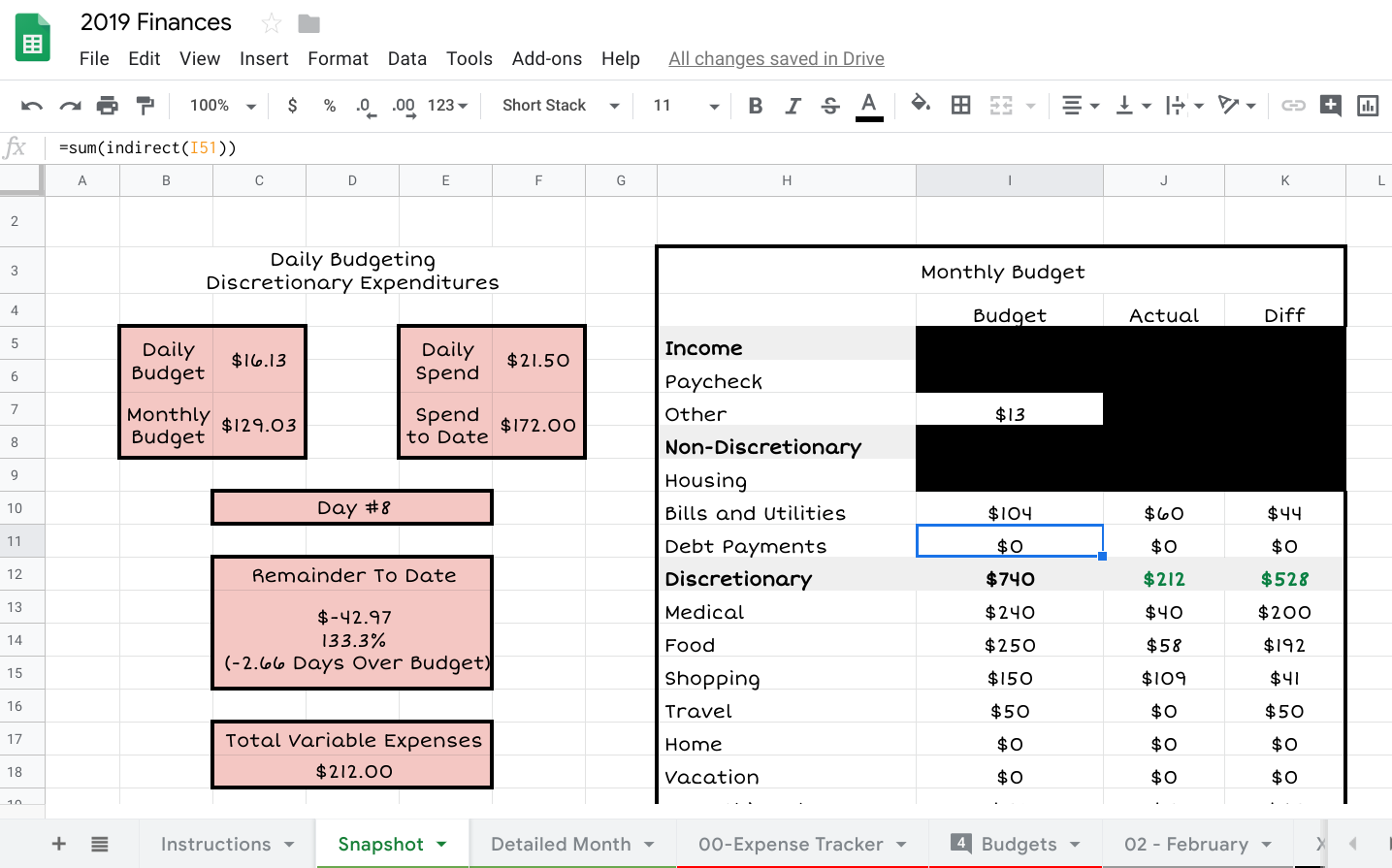
When I’m over budget everything displays in red 😦

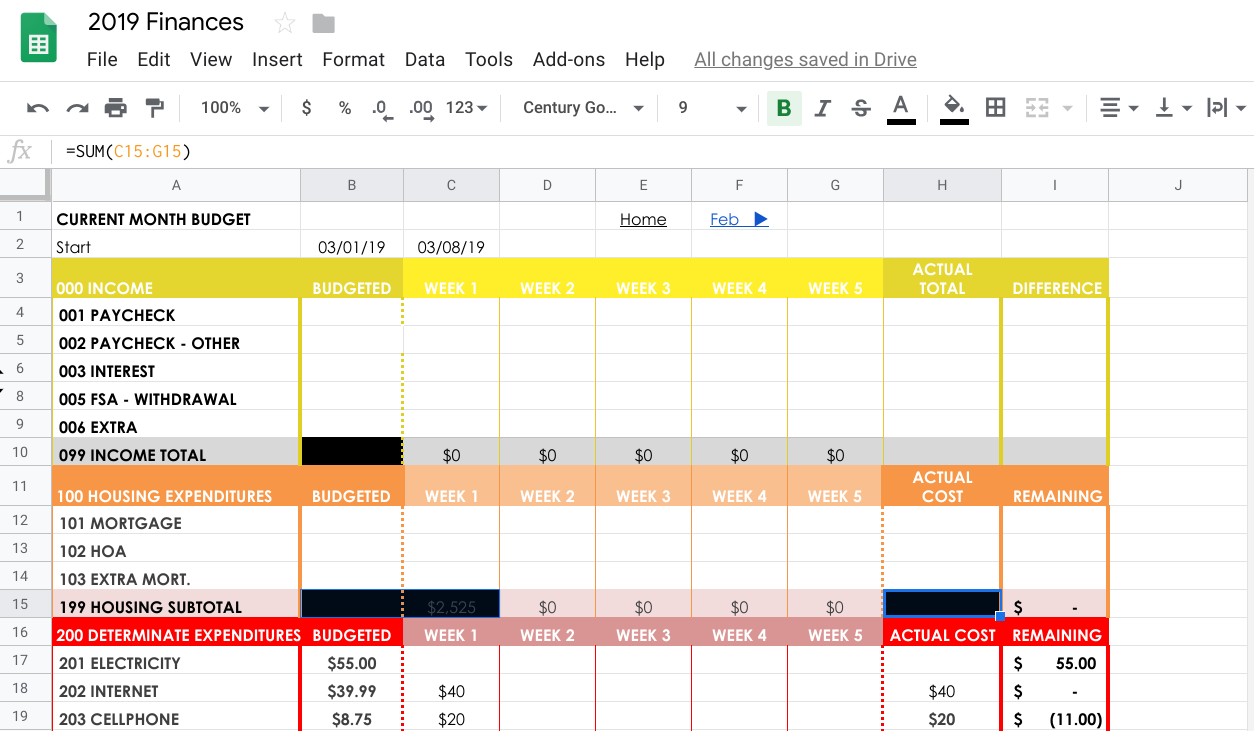
Within this document, I spend 95% of the time inputting my daily transactions and/or visualizing a snapshot of my spending-to-date. But, as stated, I do maintain other tabs as well. For instance, there is a more detailed month-to-date sheet that I rarely look at:
I use another sheet to track my net worth. I only update this at the end of the month though (A similar sheet tracks my YTD spending, but this is update automatically):

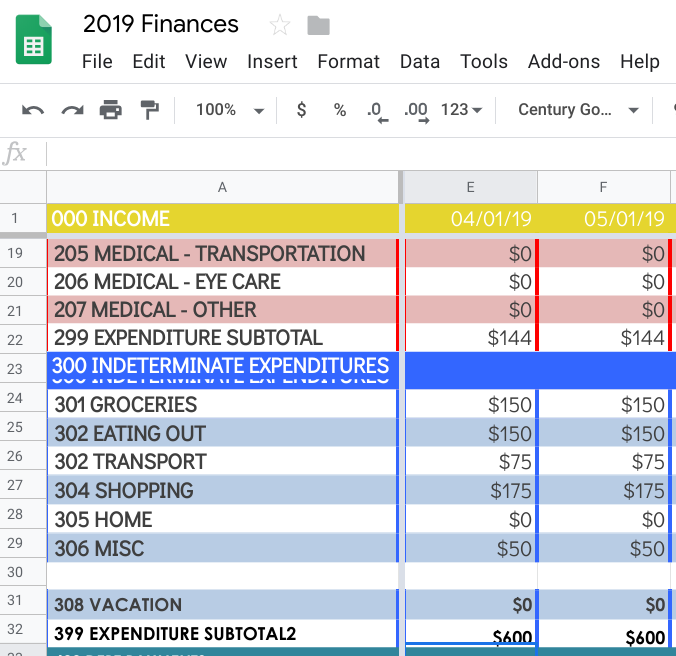
For the most part, I try to stick to the same budget from month to month, but if I need to change it, that can be done here:
Other notable features in this particular financial workbook include:

  • Instructions on how to use the document & make changes
  • Historical detailed monthly budgets
  • A paycheck calculator
  • Charts and graphs galore
  • Income tax calculator
  • Investment tracking
  • Projections

Net Worth Update – February 2019

February was an amazing month for my finances. I was awarded a bonus, received a pay raise, and got a small but significant tax refund.

Outside of the finance world things weren’t so amazing. I’m still struggling with my autoimmune disease and these new medications just don’t seem to be working well. The past couple of months I’ve had to get used to self-injecting on the daily. I’m not a fan. The medications are saving me a lot of money though, as the drug manufacturers are set to pay 80% of my out of pocket maximum indefinitely if I remain on them. But judging by how I feel, I doubt I’ll be sticking with it.

Net Worth

My net worth increased by almost $9,000 which translates to roughly 8%. I wasn’t expecting such a spectacular month.

I was almost tempted to adjust my home equity amount (upward) since a condo sold in my building and I now know the market value. But I’ll stick to my plan and only adjust it in December for a more conservative estimate.

Liquid AssetsStartEndChange
Cash & Checking$2,025$2,025+$0
Emergency Fund$5,750$6,000+$250
Savings$775$2,600+$1,825
Brokerage$1,400$1,600 +$200
HSA$275$1,025 +$750
Illiquid AssetsStartEndChange
Bonds$1,375$1,225($150)
Home Eq$28,375$28,950+$575
401K$45,375$49,025+$3,650
Roth IRA$25,875$27,225+$1,350
LiabilitiesStartEndChange
Loans($4,025)($3,550)+$475
Net Worth$107,200$116,125+$8,925
% Change+8.3%

Most of the extra cash went into savings and investments. I funded my sinking funds (referred to as savings goals), invested a little, and front loaded my HSA. The markets must have done well judging by my investment gains.

Spending

I went $38 over budget, which isn’t terrible, especially since I was under budget last month:

CategoryBudgetActualDiff
(1)Bills & Utilities$1,033$1,033$0
(2)Food$300$249$51
(3)Medical$-$322($322)
(4)Misc$300$306($6)
(5)SF$--$239$239
Total $1,633 $1,671$38 over

(1) Bills & Utilities

This category is a lot higher than the $175 I usually budget for because I paid off some outstanding debts in lump sum. To me this is not the same as going over budget since these bills would have been paid eventually.

(2) Food

I was somehow under budget on food.

(3) Medical

I had more medical expenses than I would have liked. Next month will probably have similarly high medical expenses. I’m hoping things calm down thereafter.

(4) Misc

I was slightly over budget in this category. I technically could have funded a birthday gift with a sinking fund but I cash-flowed it since it wasn’t too expensive.

(5) Sinking Fund

I paid for (some) medical expenses with money I had already set aside in a sinking fund. Other medical expenses were funded by my Chase Sapphire Travel Credits.

I actually have 8 sinking funds for various long & short term savings goals, not including my emergency fund. This month I funded my slush fund with $400 which I’m hoping will now cover any budgetary overages in March – June. That means I shouldn’t be going over budget (I hope).

Another New Budget

Due to the pay raise, I’ll be changing my budget for the third time in as many months. I hope to increase my spending in the “Miscellaneous” category from $300 to ~$500 depending on how much my paycheck ends up changing. I’m trying to cash-flow medical expenses, so this raise will definitely help. My food budget will still be $300. I do estimate that my Bills & Utilities will decrease.

What happens if I am under budget in the months ahead? My plan is to save 25% in a slush fund, save 25% in another sinking fund and invest 50%.